العربية
UltraSYStemsTechnology Servicesألترا سيستم لخدمات تقنية المعلومات

Custom software · Kuwait

Custom Software Development in Kuwait

Custom software development builds a system designed around one organisation's workflow instead of adapting the organisation to off-the-shelf software. In Kuwait, projects range from focused internal tools to full operations platforms, typically taking 8–20 weeks. Cost is driven mainly by integrations, user roles, and bilingual Arabic-English scope rather than by page or screen count.

  • We map the process before proposing anything
  • Fixed scope and price before you commit
  • You own the source code and the data
What's slowing you down:

What's breaking

Branch stock never agrees

Four spreadsheets, four versions of the truth, and purchasing done on guesswork

What we build

Stock & purchasing systemdepartmental

One live stock position across branches, with per-branch permissions and one price list

What it connects to

Your POS and accounting

Sales and costs flow through automatically instead of being re-keyed

What changes

Month-end in hours

Stock counts that reconcile, and purchasing based on what you actually hold

Not sure which of these you are? That is what the discovery session is for.

The problem

The spreadsheet that quietly became your operating system

Most businesses do not need custom software. They need one part of their operation to stop leaking time — and everything sold to them so far has either not fitted, or fitted at the cost of three workarounds. This page explains when building is the right answer in Kuwait, when it is not, what it costs, and what you own at the end.

It rarely starts as a software problem. Someone builds a spreadsheet to cover a gap the main system does not handle. It works. Then a second branch needs its own copy, someone adds a column nobody else understands, and month-end becomes a reconciliation exercise between files that disagree with each other.

By the time a business in Kuwait starts looking for custom software, the real cost is usually not the licence fee of whatever they are running. It is the hours spent every week re-keying data between systems that were never introduced to each other, and the decisions being made on numbers nobody fully trusts — usually because the data underneath them was never designed, only accumulated.

That is the problem worth solving. Not “we need a system” — but “this specific part of how we run leaks time, and nothing we can buy fits it.”
Build or buy

Should you build custom software at all?

The comparison that matters is not upfront price. It is what the two options cost you in year five, and whether you can still change direction by then.

ConsiderationOff-the-shelf / SaaSCustom build
Upfront costLow. Often free to start.Higher. The whole cost is visible on day one.
Cost at year fivePer-user licences compound. A 40-person team on a mid-tier SaaS often passes the cost of a system they would have owned.Hosting and support only. No per-seat fee.
Fit to your processYou adapt to the software. Workarounds accumulate in spreadsheets alongside it.The software matches how you already work.
Time to runningDays.8–20 weeks, delivered in usable stages.
Arabic and RTLVaries. Often partial, sometimes an paid add-on, occasionally machine-translated.Built in from the first screen.
If your process changesYou wait for the vendor's roadmap, or you leave.You change it. It is your code.
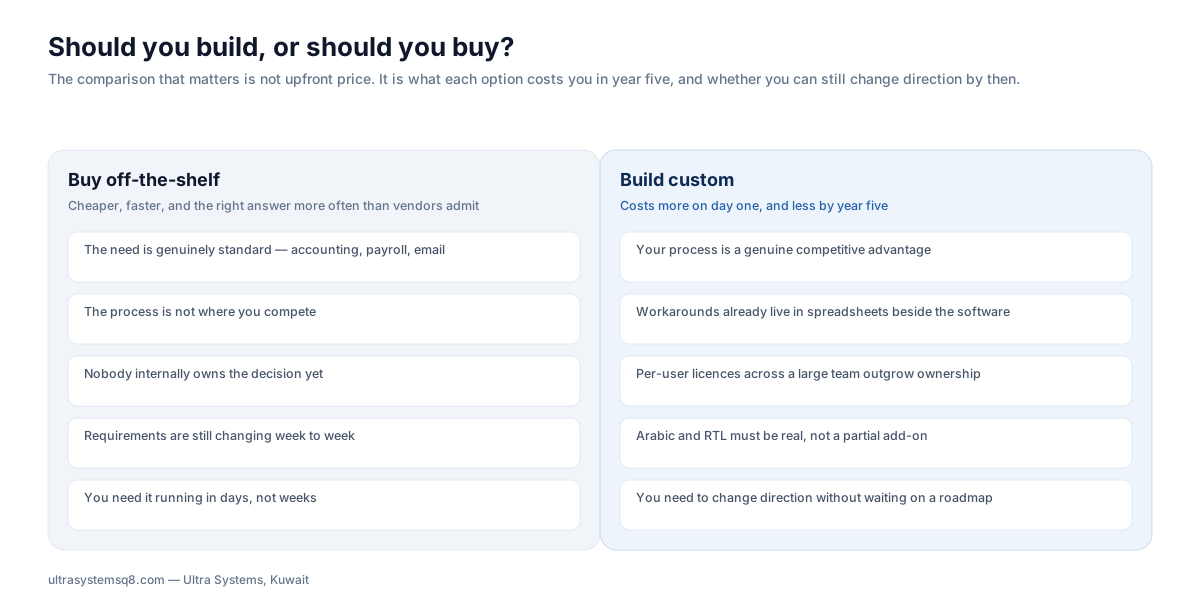
Decision test comparing buying off-the-shelf software against building custom software in Kuwait, listing five conditions that favour each option.
Five conditions on each side. If more of the left column describes you, buying is the cheaper answer and we will say so.

Straight answer

When you should not build custom software

No competitor in this market publishes this section, which is exactly why it is here. Four situations where we will tell you not to hire us.

The need is genuinely standard

Accounting, payroll, and email are solved problems. If a proven product covers what you need at a sensible price, buy it — we will tell you so, and we would rather say it in the first meeting than after you have paid.

The process itself is the problem

Building software around a broken workflow makes the workflow permanent and expensive. Sometimes the honest answer is to fix the process first and revisit the system in six months.

Nobody internally owns the decision

Custom software needs someone on your side who can answer questions and make calls. Without that, projects stall regardless of who builds them.

The requirement is still changing weekly

If the shape of the business is still moving, a smaller tool or an off-the-shelf stopgap is the cheaper bet. Build when the process has settled enough to be worth encoding.

Cost

What custom software costs in Kuwait

Published as bands rather than a single headline figure, because a one-number answer to this question is always wrong. These reflect the Kuwait market, not offshore rates.

Focused tool

from KD 3,000

One workflow, one team, few or no integrations. Replaces a spreadsheet that has outgrown itself.

Departmental system

KD 8,000 – 20,000

Multiple modules, user roles, reporting, and one or two integrations with systems you already run.

Business platform

KD 20,000 – 60,000

Core operations for the whole company — multi-site, several integrations, Arabic and English throughout.

Enterprise

KD 60,000+

Multi-entity groups, high concurrency, complex approval and audit requirements.

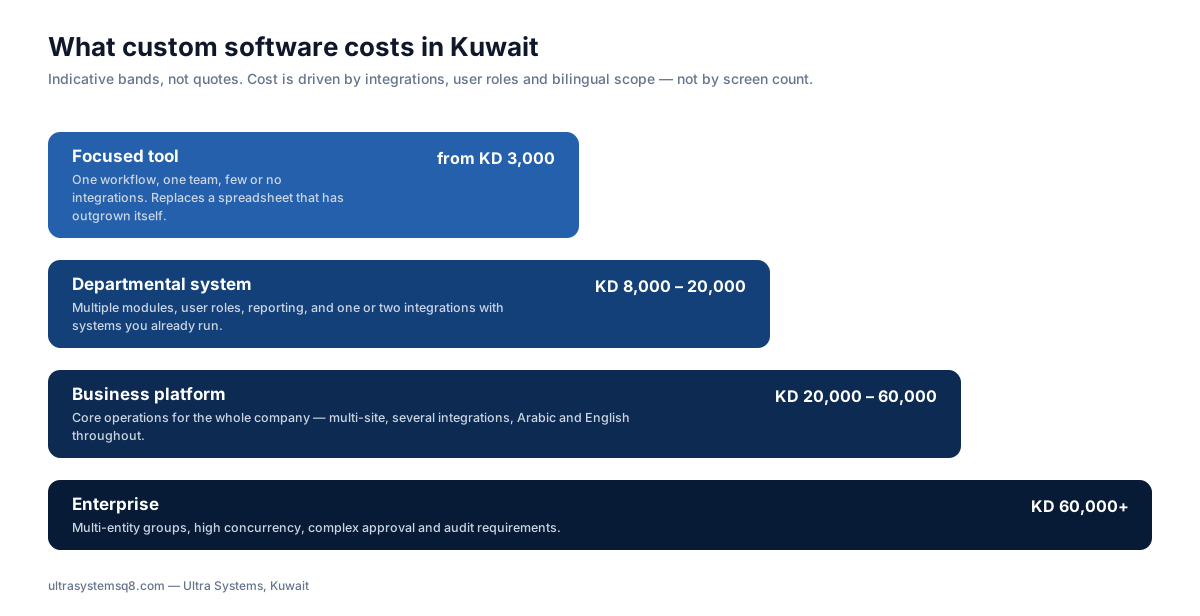
Custom software development cost bands in Kuwait: focused tool from KD 3,000, departmental system KD 8,000 to 20,000, business platform KD 20,000 to 60,000, enterprise from KD 60,000.
Bands widen with scope, not linearly with price — the gap between a departmental system and a platform is mostly integrations and roles.

What actually moves the number

Screen count barely matters. These six things decide the price.

Integrations
The largest single cost driver, and the one most often underestimated. Connecting to a system with a documented API is routine; connecting to an older local system with no API means working against its database directly, which takes longer and needs more testing.
User roles and permissions
Three roles is a morning's work. Fifteen roles with overlapping approval limits, delegation during leave, and per-branch visibility is a genuine design problem and priced as one.
Bilingual scope
Arabic and English across the interface, documents, and printed output. We build RTL from the start because retrofitting it later costs more than doing it once.
Reporting depth
A fixed set of reports is straightforward. A report builder your finance team can drive without calling us is a product in its own right.
Data migration
Moving years of history out of an old system is priced on how clean that data is, not how much of it there is.
Concurrency and uptime
A system for 20 office users and a system serving 400 concurrent branch users at month-end are different engineering problems.

On maintenance: budget for it from the start. Kuwait market rates run roughly KD 150–500 per month depending on complexity, and that is separate from where the system is hosted. Any quote that omits post-launch support has not quoted the real cost of the system. Our published starting prices cover the other services on this site.

Ownership

You own what we build. In writing, before you pay.

This is the question buyers in Kuwait most often forget to ask, and the one most vendors are quietest about. Our answer is fixed and it is in the contract:

Source code

Transfers to you on completion and final payment.

Database & schema

Yours, with documentation and full export access.

Hosting

Ours if convenient, yours if preferred. Movable either way.

Licence fees

None. No per-user charge, ever.

If you leave us

You keep a running system and everything needed to maintain it.

The specification

Yours whether or not you continue with us.

Industries

Systems we build for Kuwait businesses

The problems below are specific because the systems are. Sectors we work in across Kuwait City, Hawally, Farwaniya, Ahmadi and Mubarak Al-Kabeer.

Retail & trading

Stock across branches, purchase and pricing control, KNET-linked sales, and stock counts that match reality.

ERP for retail & trading in Kuwait →

Restaurants & cafés

Recipe and food-cost control, branch and delivery-aggregator reconciliation, and shift-level reporting.

ERP for restaurants & cafés in Kuwait →

Construction & contracting

Project cost tracking, subcontractor certificates, retention, and progress billing against BOQ lines.

ERP for construction & contracting in Kuwait →

Healthcare & clinics

Appointments, patient records, insurance workflows, and controlled access to clinical data.

ERP for healthcare & clinics in Kuwait →

Logistics & distribution

Fleet and route planning, proof of delivery, and driver apps that keep working when signal drops.

ERP for logistics & distribution in Kuwait →

Professional services

Timesheets, engagement profitability, retainer tracking, and invoicing that reflects work actually done.

ERP for professional services in Kuwait →

How a project runs

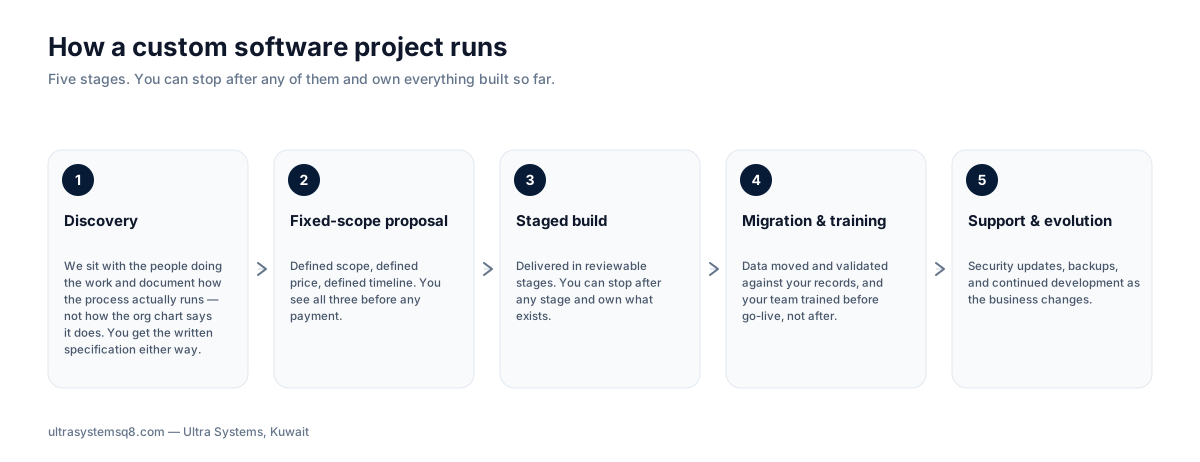
  1. 1

    Discovery

    We sit with the people doing the work and document how the process actually runs — not how the org chart says it does. You get the written specification either way.

  2. 2

    Fixed-scope proposal

    Defined scope, defined price, defined timeline. You see all three before any payment.

  3. 3

    Staged build

    Delivered in reviewable stages. You can stop after any stage and own what exists.

  4. 4

    Migration & training

    Data moved and validated against your records, and your team trained before go-live, not after.

  5. 5

    Support & evolution

    Security updates, backups, and continued development as the business changes.

What it connects to

A system that cannot talk to what you already run just creates a new island.

Technology

Front end:
React and TypeScript. Arabic and English, RTL and LTR, from the first screen.
Back end:
Node.js, .NET, or Python, chosen for the problem rather than for our convenience.
Database:
PostgreSQL, SQL Server, or MySQL — designed properly, because most performance problems are schema problems.
Mobile:
Flutter or native iOS and Android where field or customer use requires it.
Infrastructure:
Our own managed servers, or your cloud account if you prefer to hold the keys.
Integration:
REST and GraphQL APIs, webhooks, and direct database connectors for older systems.
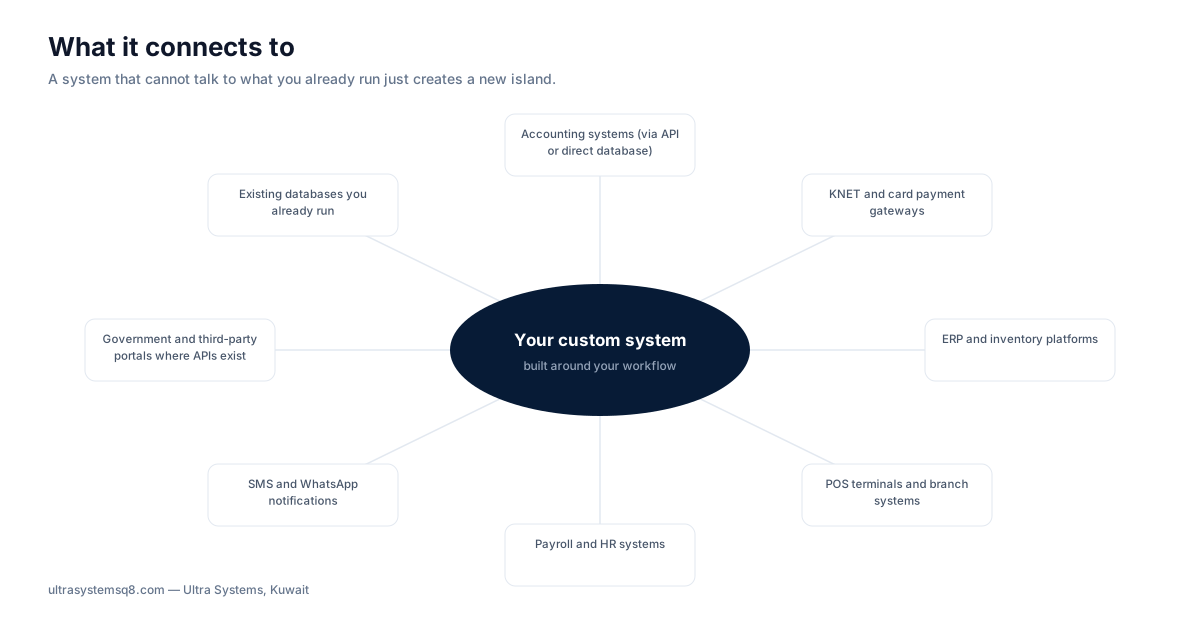
Integration map showing a custom business system in Kuwait connected to accounting software, KNET and card payment gateways, ERP and inventory platforms, POS terminals, payroll and HR, SMS and WhatsApp notifications, government portals, and existing databases.
The new system sits in the middle of what you already run. Every line here is data that stops being re-keyed by hand.
Five-stage custom software delivery process in Kuwait: discovery, fixed-scope proposal, staged build, migration and training, then support and evolution.
The specification produced at stage one is yours whether or not you continue past it.

Worked examples

What these projects look like in practice

Illustrative scenarios showing how a problem becomes a system — not client case studies. We publish named results only once real projects complete and those clients approve them, and what we can currently verify is set out on our clients and work page.

A trading company running four branches on separate spreadsheets

Problem
Stock figures disagreed between branches, so purchasing was guesswork and month-end took a week.
System
One stock and purchasing system with per-branch permissions, nightly reconciliation, and a single price list.
What changes
Stock visible in one place; month-end measured in hours rather than days.

A contractor billing progress against BOQ lines by hand

Problem
Certificates were prepared in Excel, retention was tracked separately, and disputes surfaced late.
System
Project cost tracking with subcontractor certificates, retention handling, and progress billing tied to BOQ lines.
What changes
Billing tied to measured progress; retention positions current rather than reconstructed.

A clinic coordinating appointments across three locations by phone

Problem
Double-bookings, no shared patient view, and insurance paperwork repeated by hand.
System
Shared scheduling and patient records with role-based access and insurance workflow support.
What changes
One schedule across locations; clinical data visible only to those who should see it.

Before you commit

Six mistakes that make these projects fail

These apply whoever you hire. If a vendor's answer to any of them is vague, treat that as the answer.

Writing the specification as a feature list

Instead: Describe the outcome and the constraint instead. 'Stock counts must reconcile nightly across four branches' tells an engineer far more than 'inventory module'.

Paying for the whole system before seeing any of it

Instead: Insist on staged delivery with something usable at each stage. You should be able to stop after any stage and still own what has been built.

Leaving source-code ownership out of the contract

Instead: Get it in writing before the first payment. If a vendor is vague about this, that is the answer.

Treating Arabic as a translation task at the end

Instead: RTL affects layout, sorting, date handling, and printed documents. Retrofitting it costs more than building it in.

No plan for who maintains it

Instead: Software needs security updates and changes as the business moves. Agree support terms at the start, not after the first outage.

Migrating dirty data as-is

Instead: Cleaning data before migration is cheaper than debugging a live system full of duplicates for a year afterwards.

How to judge whether it worked

Agree these before the build starts, and measure them after. Shipping a system is not the same as succeeding.

Manual hours removed

Counted per week, per role. The clearest signal a system earned its cost.

Time to close the month

If reporting still takes a week after go-live, the system did not do its job.

Data accuracy

Do stock, cash, and receivables match reality without a manual reconciliation step?

Adoption

Whether the team uses it, or quietly keeps the old spreadsheet running alongside.

Change turnaround

How quickly a needed change reaches production once you ask for it.

Answers

Custom software development in Kuwait: your questions

The questions buyers actually ask, answered directly — including the ones most vendors avoid.

How much does custom software cost in Kuwait?

Custom software in Kuwait generally starts around KD 3,000 for a focused tool covering a single workflow, KD 8,000 to KD 20,000 for a departmental system with several modules and integrations, and KD 20,000 to KD 60,000 for a platform running core operations. Cost is driven by integrations, user roles, and bilingual scope rather than screen count. We give a fixed-scope proposal after a discovery session.

Do we own the source code?

Yes. Source code, database schema, documentation, and all project assets transfer to you on completion and final payment. There are no per-user licence fees and you are not locked into us for hosting or future development. This is written into the contract before the first payment, not negotiated afterwards.

When is custom software better than off-the-shelf?

Build when your process is a genuine competitive advantage, when off-the-shelf tools require workarounds your team maintains in spreadsheets, or when per-user licensing across a large team costs more over five years than owning a system outright. Buy off-the-shelf for standard needs like accounting, payroll, or email — we will say so if that is the honest answer.

How long does a custom software project take in Kuwait?

Most business systems take 8–20 weeks from approved specification to production. We deliver in stages so usable functionality reaches your team before the full project completes, and so you can stop after any stage and still own what has been built.

Can it integrate with our existing accounting or POS system?

Yes. We integrate through documented APIs where they exist, and through direct database connections for older local systems that have none. Common integrations include accounting platforms, KNET and card gateways, POS terminals, payroll, and inventory systems, so data moves automatically instead of being exported and re-keyed.

Will the system work in Arabic as well as English?

Yes, and it is built that way from the first screen rather than translated at the end. That covers right-to-left layout, Arabic sorting and date handling, and bilingual printed documents and invoices. Retrofitting RTL after an English-only build costs considerably more than doing it once.

What happens to our system if we stop working with you?

You keep everything. You hold the source code, the database, and the documentation, and the system runs on infrastructure you can move at any time. We hand over rather than hold hostage — a system you cannot take elsewhere is a liability, not an asset.

Can you migrate data from our current system?

Yes. We extract from existing databases, spreadsheets, or exports, map the fields, clean duplicates, and validate the result against your records before go-live. Migration is priced on how clean the source data is rather than how much of it there is.

Who maintains the software after launch?

We do, under a support agreement covering security updates, backups, bug fixes, and continued development as your process changes. Kuwait market rates for maintenance run around KD 150 to KD 500 per month depending on system complexity. You may also take maintenance in-house — you own the code.

How do you keep the system secure?

Role-based access control so people see only what their job requires, encrypted connections and encrypted data at rest, audited administrative actions, automated daily backups with tested restores, and security patching as part of the support agreement. Access rules are agreed during design rather than added afterwards.

Do you work with businesses outside Kuwait City?

Yes. We work with businesses across Kuwait — Hawally, Farwaniya, Ahmadi, Mubarak Al-Kabeer and the Capital Governorate — and with clients elsewhere in the GCC. Discovery sessions happen on site where that is useful and remotely where it is not.

What do you need from us to start?

Someone who knows how the process actually works today, and the authority to make decisions about changing it. You do not need a written specification — producing that is the first thing we do, and it is yours whether or not you continue with us.

Still have a question?

Ask us directly — we answer on WhatsApp during working hours.

Ask on WhatsApp

Explore

Specific systems we build

Custom software is the umbrella. These are the systems most Kuwait businesses ask for by name.

At a glance

Custom software development in Kuwait, on one page

Everything above, condensed — the systems, the stack, the integrations, the bands, and what transfers to you at the end.

Overview of Ultra Systems custom software development in Kuwait: ERP, CRM, POS, mobile apps, AI automation and web applications; price bands from KD 3,000 for a focused tool to KD 60,000+ for an enterprise platform with KD 150–500 monthly support; React, Node.js, Python, .NET and Flutter; KNET, accounting, ERP, POS and WhatsApp integrations; full source-code ownership.
Everything on this page in one view — what we build, what it connects to, what each band costs, and what transfers to you at the end.

Start with the problem, not the software

Describe what is not working in your own words. We map the process, tell you honestly whether custom software is the right answer, and give you a fixed-scope proposal. The written specification is yours either way.

Call usWhatsAppGet a Quote